
Knowledge
Iran Conflict 2026: Global Supply Chain Crisis
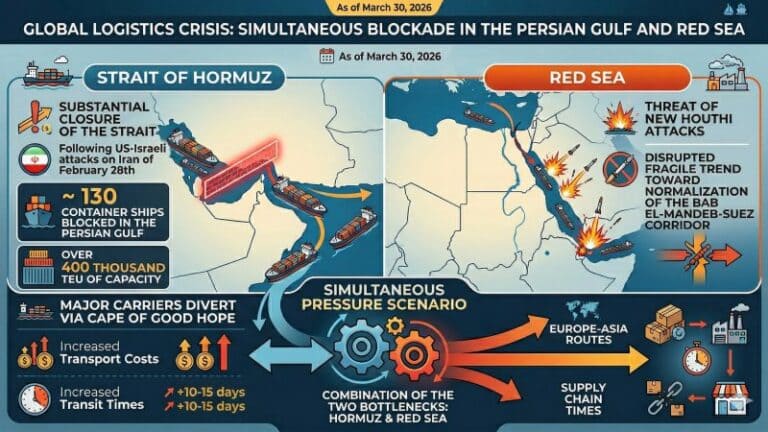
The year 2026 has been marked by an unprecedented geopolitical crisis in the Middle East. The Iran conflict has led to the effective near-closure of the Strait of Hormuz. This critical development has sent shockwaves through global supply chains, creating a dire need for stable and secure logistical solutions. As traditional maritime routes become increasingly perilous, Egypt’s strategic waterways—the Suez Canal and its Red Sea and Mediterranean ports—have emerged as indispensable alternatives for maintaining the flow of East-West trade. This article delves into the profound impact of the Iran Conflict Supply Chain, presenting precise figures and statistics. It also highlights Emdad’s pivotal role as a strategic logistics partner in mitigating this crisis for ship owners and managers.
Iran Conflict 2026: From Geopolitical Threat to Global Supply Chain Crisis
The escalating conflict involving Iran has rapidly transformed from a regional geopolitical issue into a full-blown global supply chain emergency. Consequently, businesses worldwide face unprecedented challenges.
The Strait of Hormuz Closure: A Severed Artery
The Strait of Hormuz, a narrow passage through which a significant portion of the world’s energy and trade flows, has been effectively shut down. This closure has had immediate and severe repercussions. Approximately 20% of global oil, 18% of air cargo, and 20% of the world’s seaborne natural gas trade have been directly impacted [1] [2] [3]. The sheer volume of stranded cargo is staggering. Reports indicate that over 400,000 TEUs (Twenty-foot Equivalent Units) are currently trapped in the Persian Gulf, unable to proceed [4]. This blockade has not only disrupted energy markets but has also placed immense strain on global supply chains, causing widespread delays and uncertainty. Therefore, understanding the Iran Conflict Supply Chain impact is crucial.
Soaring Costs & Risks for Global Shipping
Furthermore, the economic fallout from the Hormuz closure is substantial and quantifiable. Brent crude oil prices have surged past $120 per barrel, reflecting the immediate impact on global energy supplies. Shipping costs have skyrocketed. Large crude oil tankers (VLCCs) have seen rates exceed $400,000 per day for certain routes [5]. Moreover, maritime insurers have begun cancelling war risk coverage in the Gulf. This has led to a dramatic increase in insurance premiums to record highs, adding significant financial burden to shipping operations [6] [7]. The cumulative effect of these rising costs means that the war bill for shipping lines has climbed to an astonishing $50 million per week [8]. This directly contributes to the severe Iran Conflict Supply Chain disruption.
Unprecedented Delays & Schedule Disruptions
In addition, the conflict has introduced severe operational challenges. More than 1,100 vessels were affected by GPS and AIS jamming on the first day of the conflict, leading to navigation difficulties and safety concerns . The necessity of rerouting vessels around the Cape of Good Hope has added considerable time to transit. This lengthens voyages by weeks and causes unprecedented delays and schedule disruptions across Asia-Europe corridors [9]. This further exacerbates the Iran Conflict Supply Chain impact.
Egypt: A Strategic Lifeline for Global Supply Chains Amidst Crisis
In this environment of crisis, Egypt’s strategic maritime infrastructure offers a critical lifeline for global trade. Consequently, its role has become more vital than ever.
The Suez Canal: The Indispensable Alternative
The Suez Canal has reasserted its indispensable role as a secure and efficient maritime bypass. It offers a significant time saving of 10-15 days on Asia-Europe routes compared to the Cape of Good Hope detour [10]. This translates into substantial fuel savings, estimated between $500,000 and $700,000 per voyage. UNCTAD reports indicate that rerouting vessels around Africa’s Cape of Good Hope adds significantly to costs and transit times [11]. While Suez Canal traffic saw a temporary dip, recent 2026 data indicates a partial rebound. Major carriers are returning to the route, recognizing its strategic value and safety [12]. The Canal’s ability to provide a shorter, more predictable, and secure passage is paramount in mitigating the current Iran Conflict Supply Chain crisis.
Red Sea & Mediterranean Ports: Integrated Logistics Readiness
Egypt’s Red Sea and Mediterranean ports are demonstrating robust logistical readiness to support increased maritime traffic. This readiness is crucial for managing the Iran Conflict Supply Chain impact.
- Sokhna Port: Located within the Suez Canal Economic Zone, Sokhna boasts an initial capacity of 1.7 million TEUs annually and berths with depths of 18 meters, capable of accommodating mega-vessels [13] [14]. Its advanced infrastructure is crucial for handling diverted cargo.
- Alexandria Port: This key Mediterranean hub experienced a 41% year-on-year growth in container traffic in 2025, handling nearly 800,000 TEUs, showcasing its expanding capacity and efficiency [15].
- Damietta Port: With $170 million in expansion investments, Damietta handled its largest general cargo shipment in history in January 2026, receiving approximately 138,200 tonnes of slag, highlighting its growing capabilities [16].
These ports provide essential logistical support, including bunkering, provisions, and technical services. They assist vessels forced to alter their routes or await transit in secure anchorages. Ultimately, they help to alleviate the Iran Conflict Supply Chain impact.
Emdad: Your Strategic Partner Amidst the Crisis
In these challenging times, Emdad stands as a critical partner for ship owners and managers. We offer comprehensive and agile solutions to navigate the complexities of the global supply chain crisis.
Rapid Response & Comprehensive Services
Emdad provides a full spectrum of ship chandlery services. These include provisions, fuel, fresh water, spare parts, and technical assistance across all Egyptian ports and the Suez Canal. Our rapid response teams are equipped to handle urgent requests from vessels affected by rerouting or delays. We ensure that essential supplies are delivered promptly, minimizing operational disruptions and mitigating the Iran Conflict Supply Chain challenges.
Local Expertise & Efficient Customs Clearance
Our deep local expertise and strong relationships with Egyptian port authorities and customs officials are invaluable. Emdad streamlines customs clearance processes. We ensure that vessels receive necessary items without undue delays, a critical factor when schedules are already under pressure. Our team’s intimate knowledge of local regulations guarantees compliance and efficiency.
Tailored Solutions for Supply Chain Resilience
Emdad commits to providing customized logistics solutions. These enhance the resilience of global supply chains. We offer expert consultation to help ship owners and managers adapt to the evolving maritime landscape. We also optimize their operations and mitigate risks. By ensuring the continuity of supplies and technical support, even under the most challenging circumstances, Emdad empowers its clients to maintain profitability and operational integrity.
Frequently Asked Questions (FAQ)
- Q: What is the direct impact of the Strait of Hormuz closure on global shipping costs?
A: The closure has led to a dramatic surge in fuel costs, war risk insurance premiums (which can be cancelled by insurers), and daily freight rates. Some tanker rates exceed $400,000 per day. Overall weekly shipping costs have increased by up to $50 million. This represents a significant Iran Conflict Supply Chain impact.
- Q: How can the Suez Canal and Egyptian ports alleviate the global supply chain crisis?
A: They offer a secure, shorter, and more cost-effective alternative to routes around the Cape of Good Hope. This provides significant savings in time (10-15 days) and fuel ($500,000-$700,000 per voyage). Egyptian ports also offer robust infrastructure and comprehensive logistics support.
- Q: What specific services does Emdad provide to vessels affected by the Iran conflict?
A: Emdad offers rapid and comprehensive ship chandlery services. These include emergency provisions, technical supplies, spare parts, and efficient customs clearance. We ensure seamless support for vessels rerouted or delayed in Egyptian waters.
Conclusion
The Iran conflict and the subsequent near-closure of the Strait of Hormuz have plunged global supply chains into an unprecedented crisis in 2026. In this turbulent environment, Egypt’s strategic maritime assets—the Suez Canal and its advanced Red Sea and Mediterranean ports—stand as a beacon of stability and efficiency. They offer a vital, secure, and economically viable alternative for international trade. Emdad, with its deep local expertise, rapid response capabilities, and comprehensive logistics solutions, is the ideal strategic partner for ship owners and managers seeking to navigate these challenging waters. By partnering with Emdad, vessels can ensure operational continuity, mitigate risks, and maintain the resilience of their supply chains amidst the ongoing global crisis, effectively managing the Iran Conflict Supply Chain impact.
Author
Ibrahem elguoshy
Director
Categories
Popular Posts
Related posts
November 1, 2025
Your Guide to Choosing the Best Ship Chandler in Egypt
November 11, 2025
Ship Chandler Services: The Ultimate Guide to Marine Supply
November 21, 2025
HACCP Ship Provisions: Why Compliance is Crucial for Food Safety at Sea
December 1, 2025
MARPOL Ship Chandler Role: Navigating Vessel Waste Management

December 11, 2025
Ship Chandler Crew Welfare: Beyond Provisions in Egyptian Ports
December 21, 2025
Cold Chain Red Sea: Ship Provisioning for Freshness and Safety

January 1, 2026
Essential Technical Stores Every Vessel Needs in Egyptian Ports
January 11, 2026
Ship Chandler Crew Welfare: Essential Services in Egyptian Ports
January 21, 2026
Ship Provisioning Red Sea: Local vs. Imported Supplies Guide
February 1, 2026


